Portrait Painted by Jake's Mother
I'm Thinking of Ending ThingsPortrait Painted by Jake's Mother is a surprise portrait of Jake that The narrator carries into the novel's final reckoning with identity. When unfolded, its blurred and fragmented face is recognized as both Jake's and The narrator's: an image meant to show one person becomes evidence of their entanglement.
Purpose and Physical Appearance
Jake's mother gave the painting to The narrator as a surprise portrait of Jake. It remains in a pocket until the ending, where The narrator remembers it, takes it out, and slowly unfolds it. Paint is on the hands in the scene, a tactile detail that places the object in the midst of an intimate, difficult act of looking.
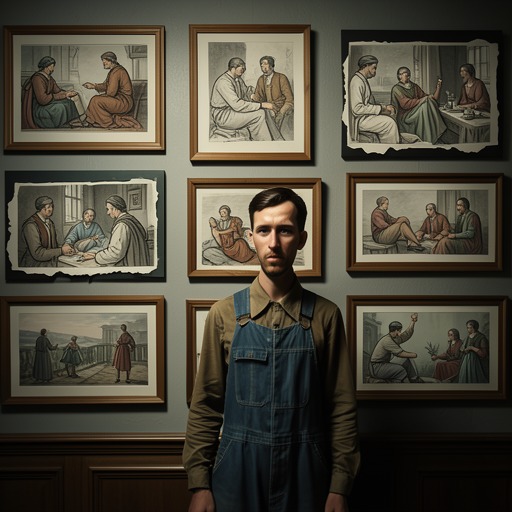
The face is present but not rendered as a clear, stable likeness. It is described as distorted, blurry, and fragmented, yet also explicit and unmistakable. The painting's uncertainty of appearance does not prevent recognition; instead, its broken image allows more than one identity to be seen in it.
Recognition and Identity
The narrator identifies the face as Jake's, then recognizes it as their own. The recognition does not resolve the distinction between them: the face is legible precisely as both. In the closing sequence, the painting gives physical form to the novel's movement among the singular identities of she, he, we, and me, without reducing that movement to a simple claim that one person has merely impersonated another.
The portrait also resonates with Jake's account of keeping a photograph of himself at five on his desk in the lab. He valued the photograph as an image of himself even though his adult body was physically different and, by his reasoning, its cells had all been replaced. The photograph raises the question of how a person remains the same through bodily change; the portrait returns that question in a more destabilizing form, presenting a face whose identity is shared and visibly divided.
Memory, Story, and the Unlived Relationship
The painting appears within a larger reconsideration of how a life becomes a story. Jake tells The narrator that memory changes with each recollection and that stories based on events can share more with fiction than fact. The portrait's recognizable yet fragmented face makes that tension visible: it offers an image that feels certain while refusing to provide a single, intact self.
The ending also recalls Jake's first meeting with The narrator at the pub. He had made it out to join other people, listened to his team's conversation, took small sips of beer, and absently sniffed the back of his hand. He wrote his number on a napkin but could not give it to The narrator. Later, the narrative imagines the possible relationship that might have followed if they had met again, while acknowledging that none of those possibilities happened. Against that unrealized history, the portrait joins Jake and The narrator in an image that exists, even as the life together it might seem to imply remains counterfactual.
Role in the Ending
The portrait is not just a keepsake recovered from a pocket: unfolding it changes what the face means. Its intended subject is Jake, but The narrator's recognition makes it an image of a self that cannot be held apart from him. The object gathers the novel's questions about memory, bodily continuity, and the stories people use to understand one another into a concrete final image—painted, carried, and finally forced into view.